
Wondering what brake pad replacement cost looks like before calling a shop? AAA puts the usual range at $150 to $350 per axle. If both axles need service, AAA puts the total at $300 to $700, and it estimates about an hour of labor per axle for a standard pad job. That gives you a starting point, but your own bill may look different.
The kind of car you drive matters. So do the pads, the rotors, and how much wear the shop finds. Strange sounds or shaking can also change what needs to be repaired.
According to AAA, replacing brake pads can cost between $150 and $350 per axle. The cost per axle can increase to $250 to $500 if the rotors also need to be replaced.
AAA also puts a standard pad replacement at roughly an hour of labor per axle, rising to two or three hours when the rotors are replaced or the brake lines are bled.
Another helpful benchmark is provided by RepairPal. Its current national estimate for brake pad replacement is $335 to $394, made up of about $213 to $215 in parts and $122 to $179 in labor. RepairPal notes the figure excludes taxes and fees and does not account for your location, so local labor, taxes, and fees can alter that figure.
| Service | Typical National Cost |
| Brake pads, AAA | $150–$350 per axle |
| Pads and rotors, AAA | $250–$500 per axle |
| Brake pads, RepairPal | $335–$394 |
Think of these prices as a ballpark figure. The shop still needs to see the brakes before giving you an exact total.
Two brake jobs can sound similar but cost very different amounts. Often, the difference is in the parts that need attention.
Things that can raise or lower the price include:
When you compare estimates, check what each one actually covers. A quote for pads only should not be compared with a quote that includes new rotors. Ask whether the price is per axle or for both, whether hardware is included, and whether the rotors are being replaced or resurfaced.
There is no single answer to how long brake pads last. Driving habits make a big difference.
Bridgestone says pads may last about 30,000 to 35,000 miles with heavy city driving. With lighter highway use, some can last more than 80,000 miles. AAA gives a similar spread, describing the general range as 30,000 to 80,000 miles.
Think about how often you stop. Daily traffic, hills, towing, and hard braking all put more work on the pads.
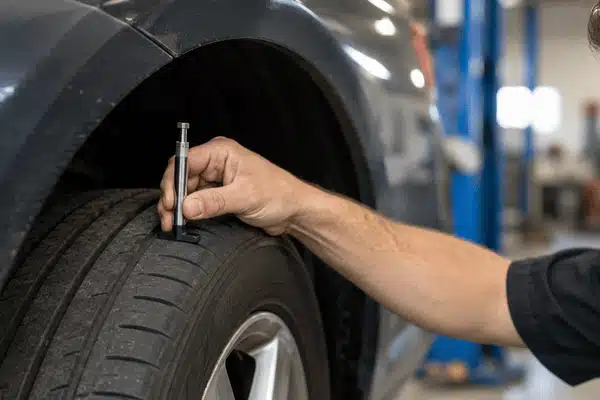
Mileage is only half the picture, because thickness is what a technician actually measures. Bridgestone suggests having the brakes inspected once the friction material is under a quarter of an inch, or about 6.4 millimeters, and AAA lists that same quarter-inch mark as a replacement indicator on a visual check.
Hybrid and electric vehicles can wear brakes differently. Regenerative braking helps slow the car, so the regular friction brakes may do less work.
A grinding noise when braking is worth checking as soon as possible. Worn brake pads are one possible cause.
Friction material is used by brake pads to stop the vehicle. Metal may start to rub against the rotor if that material wears away. This may increase the cost of a minor repair. According to Bridgestone, the sound is a deep, low noise that sounds like metal grinding or a rumbling growl. They interpret this as an indication that the pad material is gone.
Grinding does not always mean the pads are worn out. Dirt, debris, or another brake problem can make a similar sound.
Squealing can point to something else. A steady squeal may come from the small wear indicator built into some brake pads. That indicator is designed to make noise while there is still pad material left, which is why a squeal is usually the cheaper of the two sounds to act on.
Noise is not the only warning worth taking seriously. AAA’s list of brake warning signs also includes longer stopping distances, a pedal that feels low or spongy, the car pulling to one side, a burning smell that can point to overheating brakes, a clear to yellow oily fluid under the car, and the ABS light coming on.
If you have wondered why my car shakes when I brake, the rotors may be part of the problem. A pulsing brake pedal often sends technicians there first.
Uneven rotor thickness can cause vibration during braking. Too much rotor runout can also lead to uneven wear.
Drivers often hear this called a “warped rotor.” Raybestos explains that uneven thickness is often what creates the pulsing feeling.
Its technical bulletin on pedal pulsation goes further: the cause is almost always disc thickness variation produced by lateral runout, rather than a rotor that has genuinely warped.
Lateral runout is the side-to-side movement of the rotor as it turns. Raybestos says most vehicles specify two thousandths of an inch or less, and that the most common cause of excess runout is rust buildup on the hub, with uneven lug nut torque as another contributor. That is why cleaning the hub before a new rotor goes on matters as much as the rotor itself.
Still, shaking does not always start with the brakes. A proper check can help find the real cause before anyone starts replacing parts.
Yes. New pads do not automatically mean you need new rotors.
The rotors must still be thick enough to use safely. They should also be checked for cracks, deep grooves, rust, and other damage.
The minimum thickness is cast or stamped onto the rotor itself, and a technician measures the disc with a micrometer at several points around it to compare against that number.
A technician can measure them during the brake inspection. If they are still in good condition, they may stay on the vehicle.
A thorough check also covers lateral runout, because a rotor that measures thick enough can still cause a pulsing pedal if it moves more than about two thousandths of an inch as it rotates.
Texas changed its vehicle inspection rules on January 1, 2025. Most non-commercial vehicles no longer need the old annual safety inspection before registration.
Emissions testing still applies in certain Texas counties. The Texas Department of Public Safety does not list McLennan County among them.
For Waco drivers, that means there is no state-required yearly brake check for most vehicles. It is up to the driver to pay attention to wear, noises, and changes in how the car stops.
Texas also handles repair labor and parts differently for tax purposes. The Texas Comptroller says labor for motor vehicle repair is not subject to sales tax.
Parts may still be taxable, depending on how the bill is written. It is always worth asking the shop what is included in the estimate.
Texas Star Auto Repair offers brake repair that Waco drivers can turn to for pads, rotors, and brake fluid service. The shop has ASE-certified technicians and serves Waco and nearby communities.
AAA puts brake pad service at about $150 to $350 per axle. If rotors are also needed, the price may reach $250 to $500. Your vehicle and brake condition will affect the final total.
City driving can wear brake pads out around 30,000 to 35,000 miles. Highway driving may let them last much longer. How and where you drive matters just as much as mileage.
It can be. Grinding may happen when the brake pad material has worn away. Metal rubbing against the rotor can cause more damage, though debris can make similar sounds.
One possible cause is uneven wear on the brake rotors. Rotor thickness problems or excess runout can create a pulsing feeling while stopping. The brakes should be checked before any parts are replaced.
Yes, provided that using the rotors is still safe. They must be sufficiently thick and free of significant damage or cracks. New rotors are not always necessary for new pads.
Frequently, they can. By using regenerative braking instead of just friction brakes, the car can slow down. Although the brakes still require routine inspections, that might lessen pad wear.
Brake costs are different from one vehicle to the next. What matters most is catching changes early, whether that means grinding, squealing, shaking, or a change in pedal feel. For local service, Book Now with Texas Star Auto Repair in Waco for a brake inspection and quote.