
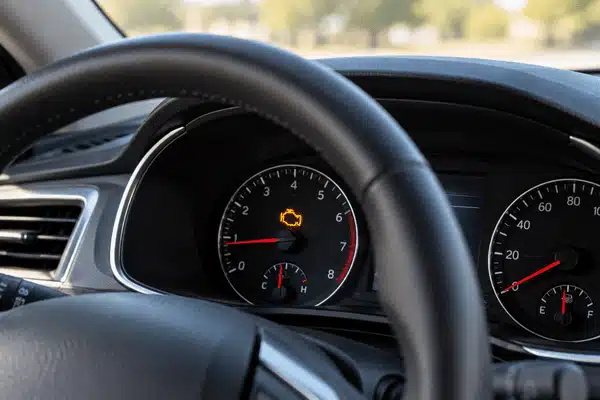
The check engine light’s meaning is pretty simple. Your car has picked up a problem and wants your attention. The issue may be small, such as a loose gas cap. It may also point to something that needs repair soon.
OBD-II, a standardized second-generation onboard diagnostic system, is installed in all cars, light trucks, and SUVs sold in the US starting with the 1996 model year. rules of the Environmental Protection Agency. Whether you drive a 2024 crossover or a 2001 pickup, the system that turns on the light functions in the same basic manner.
Your car’s onboard system keeps track of many engine and emissions functions. When it finds a fault, it can save a trouble code and switch on the warning light. The formal name for that light is the malfunction indicator lamp, or MIL, which is the term you will see in a service manual.
It is a common warning, and it is not getting cheaper to ignore. CarMD analyzed diagnostic data from more than 39 million U.S. vehicles for its 2026 Vehicle Health Index and reported that the average check engine light repair cost $554 in 2025, a 33 percent jump from the year before.
The same report noted that the average vehicle on U.S. roads is now 12.8 years old, an all-time high. Older vehicles mean more sensors, coils, and converters reaching the end of their service life.
The check engine light’s meaning depends partly on what the light is doing. A light that stays on means the car has found a fault. A flashing light usually calls for faster attention.
The onboard diagnostic system stores a trouble code when it detects certain problems. A repair shop can read that code with a scan tool.
Trouble codes follow a standard format that is the same across brands. A code such as P0301 points to a misfire on cylinder 1. A code such as P0420 points to catalyst system efficiency below the threshold the computer expects. The letter and the digits narrow down the system and the circuit involved.
The code gives the technician a place to start. It does not always tell them which exact part has failed. More testing may be needed before repairs begin.
A solid check engine light means the vehicle has found a problem that should be checked. If the car still feels normal, you can usually schedule service soon.
A flashing check engine light is more urgent. On most vehicles, it points to a severe engine misfire, which means fuel is not burning properly in one or more cylinders. Unburned fuel then passes into the exhaust, where it can damage the catalytic converter.
There is a defined technical reason for the difference. OBD-II systems sort misfires into two types. A Type A misfire is measured over a window of roughly 200 crankshaft revolutions and indicates a misfire rate high enough to damage the catalyst, so the system flashes the lamp, typically about once per second, to tell the driver that service is needed straight away. A Type B misfire is measured over roughly 1,000 revolutions, generally has to appear on two consecutive trips before it sets, and produces a steady light instead.
This is important in dollars for a straightforward reason. When raw fuel is burned inside a catalytic converter, the temperature rises and the internal substrate may be destroyed. Catalytic converters are already hot when operating normally. According to CarMD’s 2026 report, replacing catalytic converters accounted for 7.43 percent of all check engine light repairs, with an average cost of $1,511 nationwide. In contrast, the average cost of an ignition coil was $256. The less expensive repair becomes the more costly one when you drive on a flashing light.
If the light begins flashing:
| Light Type | What It Can Mean | What to Do |
| Solid | A fault needs attention | Arrange a diagnostic check soon |
| Flashing | Often linked to a serious misfire | Reduce driving and seek service quickly |
Some vehicles also use a flashing check engine light for other severe faults, and a few use a separate warning symbol entirely. Your owner’s manual may also give advice for your exact vehicle.
A check engine light on, but the car runs fine, can still mean there is a real problem. Some faults do not change the way the car feels right away.
There is usually a running cost even when nothing feels wrong. The U.S. Department of Energy and EPA fuel economy site puts it this way: the light “could be something as minor as a loose gas cap, but it could also be a more serious issue that could reduce your fuel economy, increase emissions, and/or lead to costly repairs later.” A fuel or air metering fault can quietly cost you miles per gallon long before it costs you a tow.
A loose gas cap is one example. It can cause a fuel vapor leak without affecting how the engine runs.
Gas caps are a smaller share of the problem than they once were. CarMD reported that gas cap repairs have fallen off its top ten list, largely because many newer vehicles use capless fuel filler necks. If your vehicle has no cap to tighten, a fuel vapor leak still has to be traced, often to the filler neck seal, the purge valve, or a cracked line elsewhere in the evaporative emissions system.
Sensor or emissions faults may also appear before you notice poor performance.
If the light stays solid, start by checking the gas cap. Make sure it is tight and in good shape. On a vehicle that has a cap, take it off, look at the rubber seal for cracks or grit, then refit it and turn until it clicks. If the warning stays on, book a diagnostic check.
Turning off the light is not the same as fixing the problem.
Use a scan tool to retrieve the stored trouble code.
Inspect the system connected to the code before replacing parts.
Fix the actual fault that triggered the warning.
Reset the warning only after the underlying issue is addressed.
Drive the vehicle and make sure the warning does not return.
People often look up how to reset the check engine light because they want the warning gone. Clearing the code can switch off the light, but that does not fix the fault.
Disconnecting the battery is not a shortcut either. It wipes the same stored data, and on many vehicles, it also clears radio presets, seat memory, and learned transmission or idle settings.
A better approach is to:
Clearing codes too early can remove information that may help with diagnosis.
Clearing codes also resets the readiness monitors. These are the self-tests the vehicle runs on its own emissions systems while you drive, and they drop back to a “not ready” state whenever codes are cleared or the battery is disconnected. Setting them again takes a drive cycle. A generic version published in Ohio’s state emissions program guidance involves letting the vehicle sit for about eight hours, then driving at least ten minutes at highway speeds and about twenty minutes in urban traffic with several idle periods. It may need repeating two to five times depending on the vehicle, and some manufacturers publish their own specific drive cycle.
If a loose gas cap caused the light, tightening it may solve the problem. The warning may still take several trips to turn off.
Many different faults can trigger the warning. Some common examples include:
A trouble code should be treated as a clue. The part should still be tested before it is replaced.

It is a good idea to schedule a check engine light Waco service when the warning stays on or keeps coming back.
You should get the car checked sooner if you notice:
A diagnostic check is a test, not a guess. Reading the code takes minutes. Confirming which component actually failed usually takes further testing, and that testing is what stops you from paying for a part that was never the problem.
Texas Star Auto Repair provides vehicle diagnostics for Waco drivers. The team uses scan tools and further testing to narrow down the cause before recommending repairs.
It means the vehicle found a fault in one of the systems it monitors. The computer may also store a trouble code. A scan tool can read that code and help guide the next test.
Some faults do not affect how the car feels right away. The warning may appear before you notice a drop in performance. If it stays on, have the vehicle checked.
It can be serious. A flashing light often points to a severe engine misfire. Reduce your speed and arrange service as soon as you can.
You can clear many codes with a scan tool. That does not repair the problem that caused the light. The fault should be found and fixed first.
Yes. A loose, missing, or damaged gas cap can cause a leak in the fuel vapor system. After the cap is secured, the light may take several trips to turn off.
It depends on whether the light is solid or flashing. If the check engine light is solid and the car is running normally, you can usually drive a short distance and schedule a diagnostic check soon. Do not ignore it for an extended period because some faults can reduce fuel economy or lead to more expensive repairs. If the light is flashing, reduce your speed and get the vehicle checked as soon as possible. Stop driving if the engine is shaking, losing significant power, overheating, or producing smoke or strong fuel or burning smells.
No. McLennan County is not currently part of the Texas emissions-testing program. Drivers should still have warning lights checked when they appear.
A check engine light does not always mean a major repair is coming. It does mean the car found something worth checking. Taking care of it early can help you avoid added damage and more costly repairs.
If the warning stays on, starts flashing, or keeps returning, Book Now with Texas Star Auto Repair in Waco for a diagnostic check. The team can test the system, explain the cause, and help you decide what to do next.